
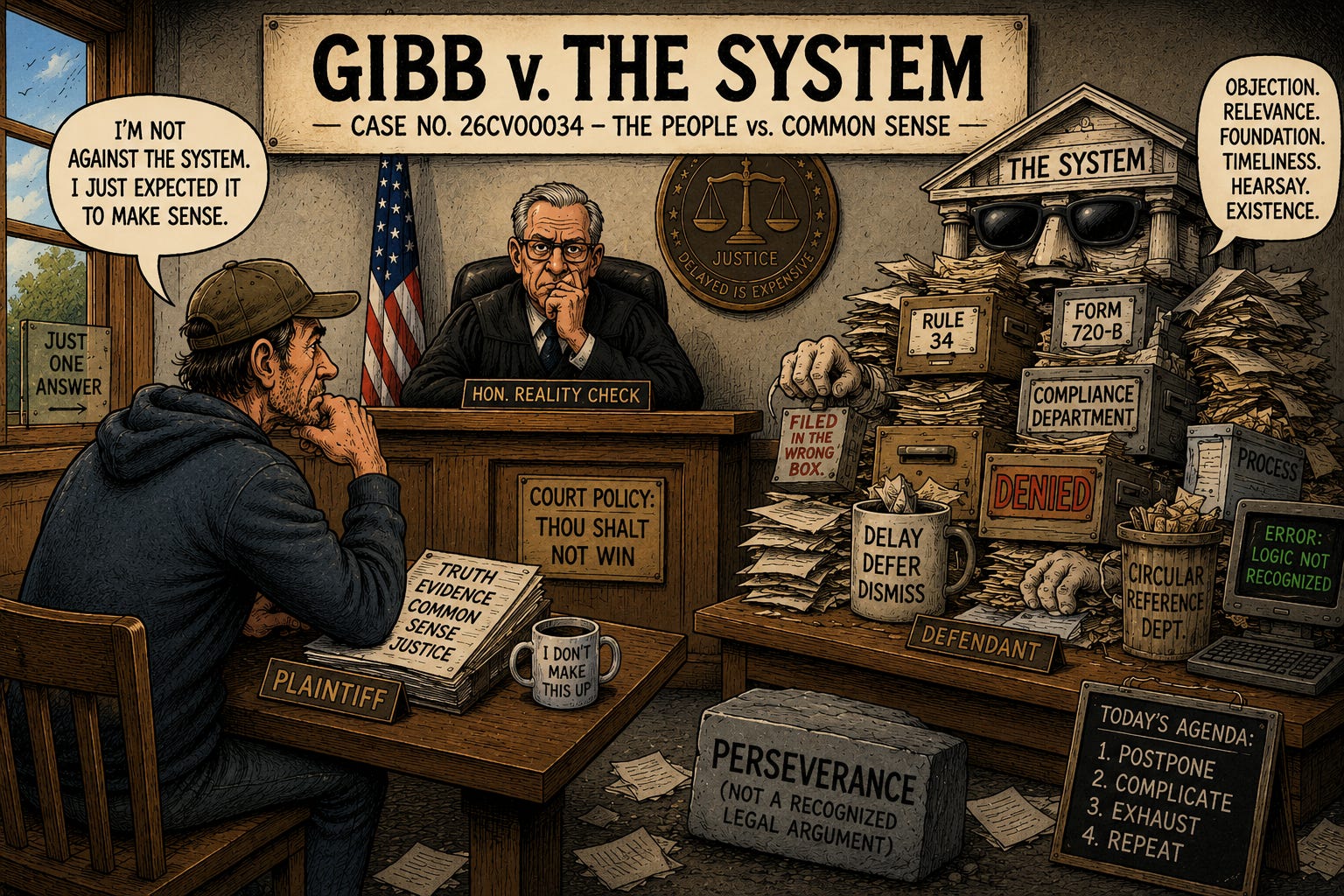
Court of Appeal of the State of California
Sixth Appellate District
GIBB v. THE SYSTEM
(2026) 97 Cal.App.5th 1 (6th Dist.)
The People v. Common Sense
OPINION
Courts exist to resolve disputes, not to perpetuate them. When a controversy has been reduced to a single identifiable question, the law generally favors answering that question rather than obscuring it beneath procedure, terminology, or institutional ambiguity. The doctrines discussed herein arise from that fundamental principle and reflect the judiciary’s longstanding preference for substance over form, clarity over verbosity, and resolution over avoidance.
This case presents no novel question of constitutional law, statutory interpretation, procedure, or public policy. Rather, it concerns a more familiar phenomenon: the migration of a simple question through an increasingly complex system. As responsibility passes from person to person, department to department, and entity to entity, the answer remains elusive while the question remains unchanged. The Court therefore begins where the parties should have begun: with the answer rather than the question itself.
The Two-Word Sentence Doctrine
Nothing in California law establishes a minimum word requirement for a legally cognizable proposition. Courts evaluate substance, not syllable count. (Code Civ. Proc., § 452; MIP Holdings, Inc. v. The System (1962) 137 Cal.App.5th 13–17 [6th Dist.].)
The purpose of language is communication. Where a statement successfully conveys the material issue in dispute, additional words may improve style but do not necessarily improve meaning.
The Court therefore adopts the Two-Word Sentence Doctrine, which provides:
A proposition expressed in two words is legally sufficient when those two words identify the controlling issue more efficiently than a longer explanation.
Examples include:
State grounds.
Nonperformance continues.
Show authority.
Produce records.
In each instance, the listener immediately understands the issue requiring resolution.
The Court further observes that excessive verbiage may obscure issues that are otherwise straightforward. A concise statement that accurately identifies the dispute is entitled to the same consideration as a lengthy memorandum. The law rewards clarity, not word count.
The doctrine further establishes that where a petitioner or plaintiff constructs substantive argument around two, consecutive, two-word sentences, the Court shall proceed to proceed, forthwith.
The Good Enough Doctrine
The Court also rejects the proposition that a litigant must present a flawless theory at the pleading stage.
California follows a policy of liberal construction. (Code Civ. Proc., § 452.) The relevant inquiry is whether the pleading gives fair notice of the claim and alleges facts sufficient to support relief if proven. (PIP G. Enterprises v. The System (1972) 211 Cal.App.5th 43, 47 [6th Dist.].)
Accordingly, the Court recognizes the Good Enough Doctrine:
A pleading is good enough when the Court understands the claim, the respondent or defendant understands the claim, and the law provides a remedy if the alleged facts are true.
The Do-What-You-Don’t-Want-To-Do Doctrine
For centuries, functioning legal systems have depended upon individuals performing acts they would prefer not to perform. Witnesses testify. Parties produce documents. Lawyers answer discovery. Judges read filings. Citizens serve on juries. Clerks lodge documents. (Richard Industries Ltd. v. The System (1999) 1511 Cal.App.5th 1, 31, 37 [6th Dist.].)
The administration of justice would collapse if legal obligations were conditioned upon personal enthusiasm.
Accordingly, the Court recognizes the Do-What-You-Don’t-Want-To-Do Doctrine, a principle so fundamental that it rarely requires express articulation:
When the law imposes a duty, the burdened party must perform that duty notwithstanding a preference not to do so.
The doctrine is routinely observed in daily legal practice.
The You-Know-What-Goes-Here Doctrine
The Court recognizes that there comes a point in certain disputes where the controlling issue has been identified so many times, from so many angles, that repetition ceases to add analytical value. (Contextually Oblivious LLP. v. The System (2008) 67, 71 Cal.App.5th 23, 29 [6th Dist.].)
Accordingly, the Court adopts the You-Know-What-Goes-Here Doctrine:
Where the parties, the Court, and the record all understand the unresolved question, a litigant may refer to that question indirectly without loss of meaning.
The doctrine applies only where the omitted proposition is obvious from the context of the proceedings.
CONCLUSION
Utilizing the aforementioned doctrines: The Court has reviewed the briefs, the declarations, the exhibits, the objections, the demurrers, the correspondence, the supplemental correspondence, the supplemental supplemental correspondence, the correspondence concerning the supplemental correspondence and the 479 page memorandum of points and authorities.
The controlling issue remains unchanged.
State grounds.
Respondent either can or cannot.
If it can, it shall.
If it cannot, it shall explain why.
The law requires an answer.
DISPOSITION
The demurrer is overruled.
Respondent is hereby directed to provide a verified answer under penalty of perjury.
IT IS SO ORDERED.
The Honorable Judge Common Sense