
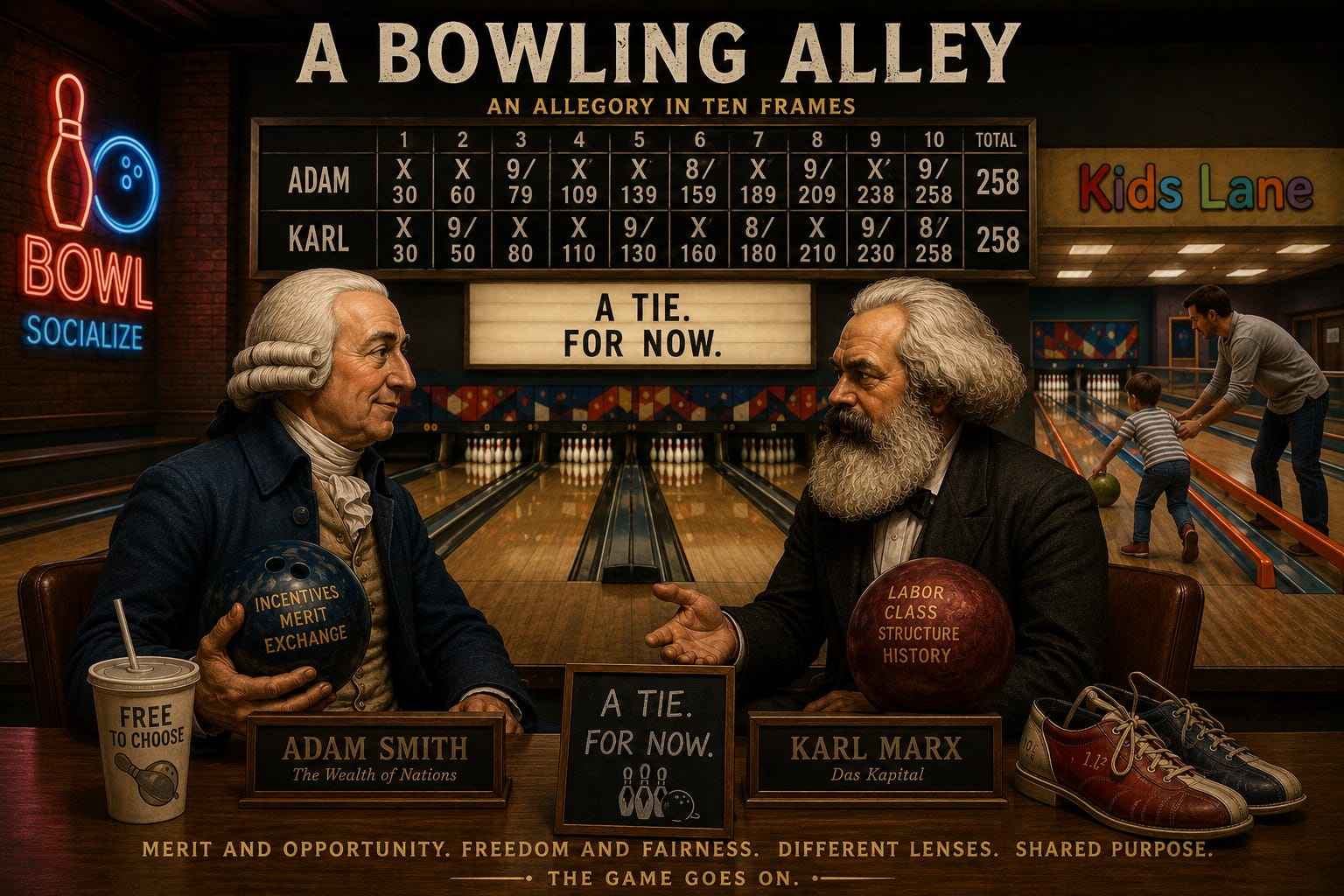
ADAM Hi Karl.
KARL Hey Adam.
ADAM How about a game?
KARL Sure.
ADAM You know the rules.
KARL Yes, and they are unfair.
ADAM Who goes first?
KARL First mover advantage.
ADAM C’mon Karl. We will just flip for it.
KARL Even coins have owners.
ADAM Let’s not go there right now. Let’s just play.
KARL Fine. But remember, someone built the alley, owns the alley, and profits from every frame we bowl.
ADAM And yet here we are, voluntarily participating.
KARL Participation and choice are not always the same thing.
ADAM Ten frames, Karl. Just ten frames.
KARL History has shown that temporary arrangements have a habit of becoming permanent. You can flip.
(KARL flips the coin.)
KARL Heads.
ADAM See? Participation.
KARL Consent under existing conditions.
ADAM You won the toss.
KARL For now.
(KARL steps up to the approach and bowls. It is a strike.)
ADAM Interesting.
KARL What?
ADAM You seem remarkably proficient at an unfair game.
KARL Understanding a system is not the same as endorsing it.
ADAM Yet you accepted the rules, flipped the coin, and bowled a strike.
KARL One can succeed within a system while questioning its legitimacy.
ADAM Fair enough. Nice shot.
KARL Labor applied to material conditions.
ADAM It’s bowling, Karl.
KARL Bowling is never just bowling.
(ADAM steps up to the approach and bowls. It is a strike.)
ADAM Incentives matter.
KARL Access to practice matters.
(KARL steps up and bowls another strike.)
ADAM Must everything become a dissertation?
KARL Only the important things. Your turn.
(ADAM steps up and bowls another strike.)
ADAM There. The invisible hand.
KARL The invisible hand had excellent lane conditions.
ADAM You don’t believe in merit?
KARL I believe merit exists. I question who gets the opportunity to demonstrate it.
ADAM You sound as though the pins conspired against you.
KARL History suggests the pins generally favor those already standing closest to them.
ADAM We are the same distance from the pins.
KARL Precisely. Institutions rarely intend injustice. They merely reproduce it efficiently.
ADAM And yet here we are, two strikes, no revolution.
KARL The evening is still young.
(A brief passage of time)
ADAM Final frame.
(ADAM bowls a spare. KARL follows and bowls a spare.)
ADAM A tie.
KARL Temporary equilibrium.
ADAM Can’t you just say we played well?
KARL History rarely ends in a draw.
ADAM Bowling occasionally does.
(They both look over toward the adjacent children’s lanes. A parent is struggling to explain the game to a young child whose ball keeps drifting into the gutter.)
ADAM Bumpers?
KARL Bumpers.
(Together, ADAM and KARL walk over to the child’s lane and manually lift the guard rails into place.)
ADAM Eventually they come down.
KARL Eventually.
ADAM Otherwise they never learn the game.
KARL Otherwise they never stay in it long enough to learn.
(They watch as the child rolls the ball. It bounces off both bumpers, wanders down the center toward the pins, and knocks down three.)
ADAM Progress.
KARL Participation.
ADAM We’ll call it a tie.
KARL For now.
END OF PLAY